In-situ testing forms the backbone of reliable geotechnical investigations in Guelph, providing engineers and contractors with direct measurements of subsurface conditions without removing soil samples from their natural state. This category encompasses a range of field tests that evaluate soil density, strength, permeability, and deformation characteristics right where they matter most—at the project site. For a city experiencing steady residential and commercial growth, understanding the ground beneath a proposed structure is not just a regulatory requirement but a fundamental safety and cost-control measure.
Guelph's geological setting presents unique challenges that make in-situ testing particularly valuable. The city sits atop the Guelph Formation, a Silurian dolostone bedrock that is often overlain by glacial till, outwash deposits, and localized clay plains. The thickness and composition of these overburden soils can vary dramatically over short distances, influenced by the Paris Moraine and the Speed River valley. This variability means that laboratory tests on disturbed samples may not capture true in-situ behavior, especially for granular soils or sensitive clays. Field tests like the field density test (sand cone method) become essential for accurately determining compaction levels in these heterogeneous deposits.
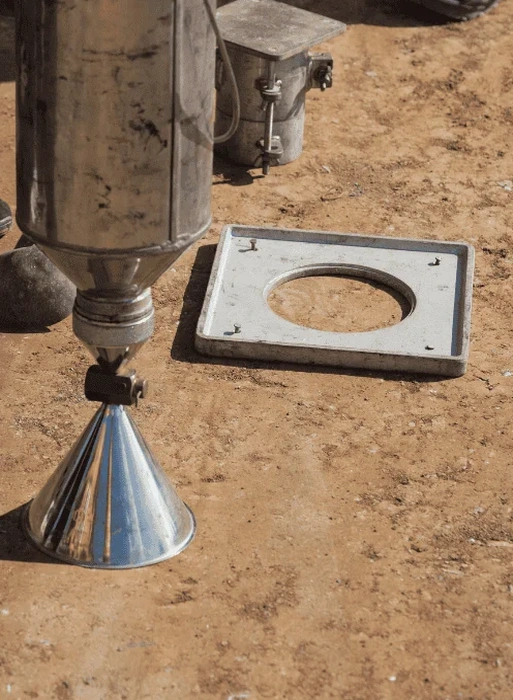
Canadian standards govern all in-situ testing procedures to ensure consistency and reliability across projects. In Ontario, the primary reference is CSA A23.2/A23.1 for concrete and aggregate testing, but for soil-specific field tests, ASTM International standards are widely adopted, including ASTM D1556 for the sand cone density method and ASTM D6938 for nuclear gauge testing. Additionally, the Ontario Building Code references the Canadian Foundation Engineering Manual and requires geotechnical reports to include field test data when assessing bearing capacity, slope stability, or pavement design. Professionals conducting these tests in Guelph must be licensed by Professional Engineers Ontario (PEO) and follow the association's strict ethical and technical guidelines.
The types of projects in Guelph that demand comprehensive in-situ testing are diverse. Low-rise and mid-rise residential subdivisions require compaction verification for engineered fill beneath footings and floor slabs. Institutional buildings at the University of Guelph often involve deep excavations where in-situ shear strength data guides shoring design. Infrastructure projects, such as road widenings along Gordon Street or watermain replacements in the downtown core, rely heavily on in-situ density and stiffness measurements to ensure long-term pavement performance. Even smaller-scale renovations in heritage areas like the Ward can uncover undocumented fill that requires immediate field assessment to confirm stability before construction proceeds.
Available services
Common questions
What is in-situ testing and why is it preferred over laboratory testing for some soil types?
In-situ testing measures soil properties directly in the ground without removing or disturbing samples. It is preferred for granular soils like sands and gravels, which are difficult to sample intact, and for sensitive clays whose structure changes when excavated. These tests provide more accurate data on density, strength, and permeability under natural stress conditions.
Which in-situ tests are most commonly required for residential construction in Guelph?
For residential projects, the most common in-situ tests include the sand cone density test for verifying engineered fill compaction beneath footings and slabs, and dynamic cone penetration tests for assessing subgrade strength. If the site is near the Speed River or has deep clay deposits, vane shear tests may also be needed to evaluate cohesive soil stability.
How do Ontario regulations affect in-situ testing requirements for building permits in Guelph?
Ontario Building Code requires geotechnical reports for most new construction, and these reports must include field test data when evaluating bearing capacity or slope stability. Municipal permit applications in Guelph typically request proof of compaction testing for engineered fill. Tests must follow ASTM or CSA standards and be conducted or supervised by a PEO-licensed professional.
What geotechnical challenges in Guelph make in-situ testing particularly important?
Guelph's variable overburden, ranging from thin soils on the Guelph Formation dolostone to thick glacial till and clay pockets, creates unpredictable subsurface conditions. The Paris Moraine and Speed River deposits add further complexity. In-situ testing identifies these variations accurately, preventing issues like differential settlement or inadequate bearing capacity that could arise from relying solely on borehole samples.