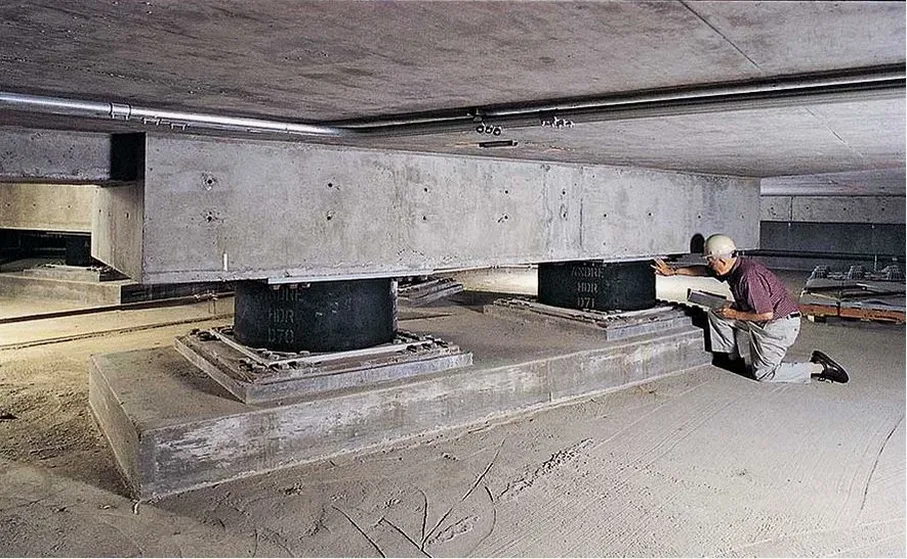
Guelph’s architectural fabric, from the historic limestone downtown to the modern subdivisions near the Hanlon Expressway, reflects a city that has grown carefully over its deep glacial deposits. The Royal City sits on a complex stratigraphy of till and outwash, where the impedance contrast between stiff lodgement till and softer glaciofluvial sands can amplify seismic waves in ways that uniform building codes only partially address. When conventional lateral-force-resisting systems reach their practical limits, particularly for essential facilities or post-disaster buildings, we introduce base isolation seismic design as a strategy that works with the ground rather than against it. This approach, which draws on the principles first formalized in the 1970s and now codified in NBCC 2020 and ASCE 7, inserts a flexible interface at the foundation level where elastomeric or sliding bearings permit the soil to move while the superstructure remains relatively still. In Guelph, where the seismic hazard is moderate but the consequences of downtime for critical infrastructure are severe, the decision to isolate a building often hinges on a detailed site-specific seismic microzonation study that quantifies the amplification potential of the overburden soils before any bearing design begins.
Base isolation in Guelph is not just about inserting bearings; it is about designing an entire interface that stays functional through freeze-thaw cycles while the ground moves independently.
Scope of work in Guelph
Local geotechnical conditions in Guelph
A six-storey medical office building on Gordon Street, constructed in the 1980s on a conventional spread footing foundation over 12 meters of soft clay, began showing distress after a moderate seismic swarm near Lake Ontario. The differential settlement that followed, though only 18 millimeters, was enough to misalign the surgical suite partition walls and trigger a costly operational shutdown. Investigation revealed that the soft clay amplified ground motion at a period close to the building’s fundamental mode, creating a near-resonant condition that a fixed-base design could not escape. Retrofitting the structure with base isolation would have decoupled the building period from the soil’s predominant period, but the owner decided instead to invest in a new isolated wing. That case underscores a reality in Guelph: the soil column often dictates the seismic demand more than the bedrock motion, and ignoring the site-specific amplification when assessing isolation feasibility leads to underdesign of the isolation plane and overstress in the superstructure. A thorough liquefaction assessment of the bearing stratum is non-negotiable before any isolator procurement begins.
Our services
Our base isolation design process in Guelph moves from concept through commissioning with a focus on constructability and long-term inspection access. The two core service packages we deliver are described below.
New-Building Isolation Design & Peer Review
Full design of the isolation plane for new essential and high-importance structures, including bearing selection, nonlinear time-history analysis with site-specific ground motions, moat detailing for Ontario winters, and third-party peer review coordination. We deliver stamped design reports that demonstrate compliance with NBCC 2020 Cl. 4.1.8.18 isolation requirements.
Seismic Retrofit Isolation Feasibility & Implementation
Assessment of existing buildings for isolation retrofit viability, including jacking load path analysis, temporary shoring design, and staged construction sequencing that keeps the facility partially operational. We evaluate the cost-benefit ratio against conventional strengthening and prepare the isolation interface design for heritage-sensitive structures where exterior appearance cannot be altered.
Common questions
What is the typical cost range for base isolation seismic design in Guelph?
How does the NBCC 2020 address base isolation compared to older codes?
NBCC 2020 adopts the provisions of ASCE 7-22 Chapter 17 by reference, which means the design must demonstrate through nonlinear response-history analysis that the isolated structure meets specific performance objectives at both the Design Earthquake (DBE) and Maximum Considered Earthquake (MCE) levels. The code also requires prototype testing of at least two isolator samples per type, and the moat wall design must accommodate the total maximum displacement plus a 5% amplification factor.
What soil conditions in Guelph make base isolation a preferred solution?
Soft to firm clay deposits and loose glaciofluvial sands, common in the Speed River valley and parts of south Guelph, tend to amplify long-period ground motion. When a site-specific seismic hazard analysis shows that the soil column produces spectral accelerations at periods above 1.0 second that exceed the code uniform hazard spectrum, fixed-base design becomes inefficient. Isolation shifts the structural period beyond the amplified range, reducing base shear by 40–60% compared to an equivalent fixed-base design on the same soil profile.