Guelph’s architectural fabric, from the historic limestone buildings downtown to the expanding residential subdivisions in the south end, rests on a complex glacial legacy. The last ice age left behind a mantle of Port Stanley Till—a dense, silty clay matrix with embedded stones—overlying the fractured dolostone of the Guelph Formation. Constructing on this interface without a detailed soil mechanics study introduces risks that range from excessive differential settlement to groundwater infiltration during excavation. The transition zones between the till plain and the Speed River valley, where alluvial sands and silts dominate, demand an entirely different set of bearing capacity assumptions. A rigorous test pits program often serves as the first step to log stratigraphy visually, while an atterberg limits analysis on the fine fraction reveals whether the till is susceptible to volume change during wet-dry cycles—a frequent challenge in southwestern Ontario’s seasonal climate.
Guelph's Port Stanley Till can lose over 40% of its undrained strength when remolded during construction—a sensitivity that demands careful sampling and laboratory simulation.
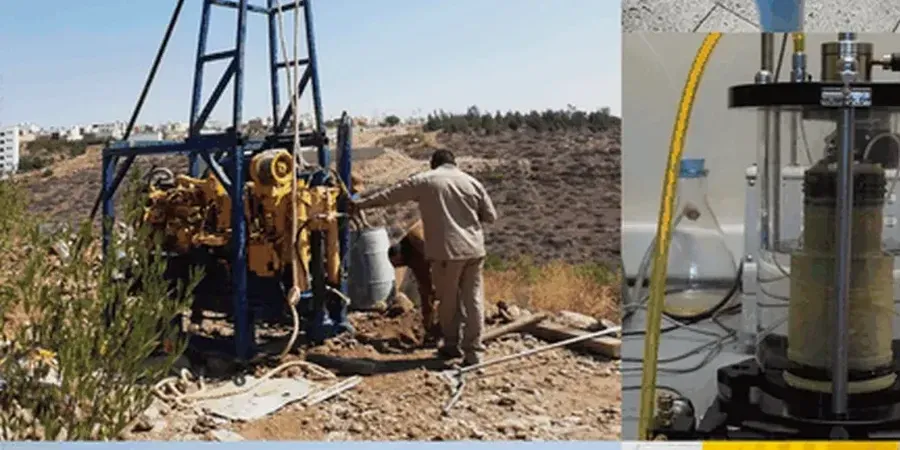
Scope of work in Guelph
Live process video
Local geotechnical conditions in Guelph
Southern Ontario’s freeze-thaw cycles, which penetrate up to 1.5 meters in Guelph during February cold snaps, combine with spring snowmelt to create some of the most aggressive shallow foundation conditions in the region. Frost heave in clay-rich tills can lift footings unevenly if they are not placed below the design frost depth, while rapid thawing saturates the upper soil layers and temporarily reduces bearing capacity by 30 to 50 percent. A soil mechanics study that ignores seasonal groundwater fluctuation misses the mechanism behind many basement wall cracks and garage slab movements observed in older Guelph neighborhoods. The Speed and Eramosa river corridors introduce an additional liquefaction consideration: loose saturated sands in the floodplain, though uncommon, could mobilize during a distant seismic event originating from the Western Quebec Seismic Zone. Evaluating cyclic stress ratios against normalized SPT blow counts provides the quantitative basis for either dismissing or mitigating this risk.
Our services
A targeted soil mechanics study in Guelph moves beyond generic textbook parameters and addresses the specific geological transitions that define the city's terrain. The following service packages reflect the most requested combinations for local projects, from infill housing near downtown to greenfield development in the south end.
Foundation Design Soil Package
Combines SPT drilling, grain size analysis, Atterberg limits, and unconfined compression testing on Shelby tube samples. Delivers allowable bearing capacity, estimated settlement, and frost protection recommendations for shallow foundations in accordance with NBCC 2020 and CSA A23.3.
Excavation and Slope Stability Assessment
Shear strength profiling via triaxial testing and in-situ vane shear measurements for projects adjacent to Speed River slopes or deep basement cuts. Includes groundwater monitoring, effective stress parameter determination, and global stability analysis using limit equilibrium methods.
Common questions
What is the typical cost range for a soil mechanics study in Guelph for a single-family home lot?
How does the Guelph Formation dolostone affect foundation design?
The Guelph Formation dolostone provides excellent end-bearing capacity, but its upper surface can be irregular and occasionally contains dissolution features or soft shale partings. A soil mechanics study typically advances boreholes at least 3 meters into competent rock to confirm rock quality designation (RQD) above 50 percent, which ensures that drilled shafts or socketed piles will perform as designed without unexpected settlement.
Do I need a soil mechanics study for an addition to my existing home in Guelph?
Yes, Guelph building permits for structural additions generally require a soil mechanics study signed and sealed by a professional engineer licensed in Ontario. The study verifies that the existing foundation soil can support the new loads and identifies any potential differential settlement issues between the old and new foundation elements.