Guelph's geological setting on the Guelph Formation—dolostone bedrock capped by glacial till and occasional loose sandy lenses deposited by the Speed River—creates a specific challenge for foundation engineering. You get pockets of poorly graded sand and silty sand that look decent at surface but prove problematic once a structural load is applied. When we assess sites near the Hanlon Creek or in the south-end industrial parks, the standard penetration test often reveals N-values below 10 in these granular layers, a clear indicator that natural compaction is insufficient for anything heavier than a two-story residential slab. This is where a thorough vibrocompaction design becomes essential, not just a checkbox item. Our technical team applies the methodology outlined in ASTM D6066 to evaluate the feasibility of deep vibratory densification, considering grain size distribution, fines content, and the existing relative density to predict post-treatment performance. To complement the subsurface characterization, we often recommend an SPT drilling program that targets the specific depth intervals suspected of containing these loose deposits, ensuring the vibro design parameters are locked onto real field data rather than generic assumptions.
Achieving 70% relative density in Guelph's loose alluvial sands cuts post-construction settlement by more than 80% compared to untreated ground.
Scope of work in Guelph
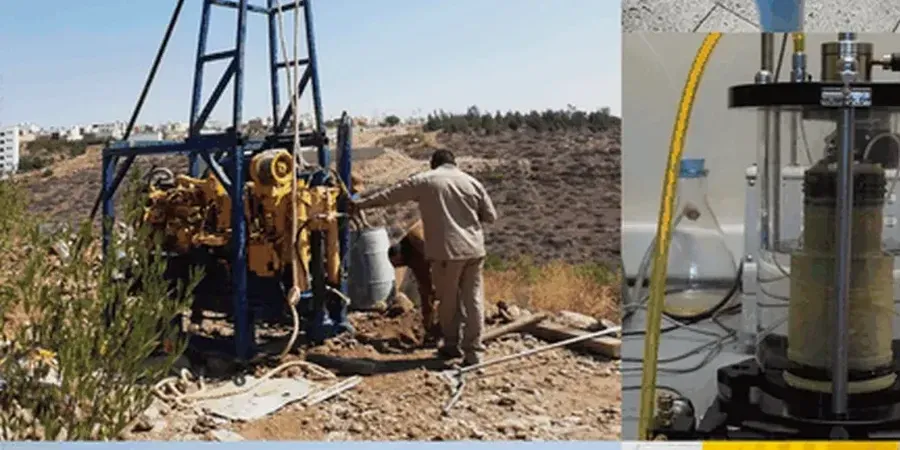
Local geotechnical conditions in Guelph
In Guelph, we frequently see contractors attempting to bypass a formal vibrocompaction design on small commercial lots, relying instead on shallow dynamic compaction with a standard excavator-mounted plate. The result is a surface crust of densified material—maybe the top 0.5 m—while the underlying 3 to 4 meters of loose sand remain practically untouched. This hidden defect becomes painfully obvious during the first winter freeze-thaw cycle or after a heavy rain event when differential settlement cracks start propagating through slab-on-grade floors. Another risk specific to the Speed River corridor is the presence of a seasonally high groundwater table, which can drastically reduce the effectiveness of vibratory energy if not properly accounted for in the design phase. A saturated loose sand may require pre-drainage or a modified compaction sequence to avoid pore pressure buildup and localized liquefaction during treatment. Our design explicitly addresses the groundwater regime by analyzing the soil's coefficient of permeability—often from an in-situ permeability test—to schedule the work during the driest months, typically late July through September, when the water table in Guelph is at its lowest.
Our services
Our vibrocompaction design package covers the full project lifecycle, from feasibility analysis to construction support. The following services ensure that the densified ground meets the performance criteria specified by the project's geotechnical engineer of record.
Feasibility and Desktop Study
Review of existing geotechnical data, grain size curves from grain size analyses, and site geology to determine if the soil is amenable to vibratory densification based on fines content and gravel fraction.
Detailed Design and Grid Layout
Development of compaction point spacing, probe penetration depth, vibrator specifications, and energy input curves. The design targets a uniform post-treatment response validated by CPT.
Quality Control and Verification Testing
Supervision of field operations and execution of pre- and post-compaction CPT tests to confirm that the specified cone resistance profile has been achieved across the entire treatment area.
Liquefaction Mitigation Reports
Specialized design package for sites in Guelph with a seismic category requiring liquefaction analysis per NBCC 2020, including post-densification factor of safety calculations.
Common questions
What is the typical cost range for a vibrocompaction design in Guelph?
How deep can vibrocompaction effectively treat the loose soils we see in Guelph?
With modern electric or hydraulic vibrators in the 130–180 kW range, we can effectively densify clean to slightly silty sands to depths of 15 meters. In Guelph's glacial and alluvial deposits, the treatment depth is usually limited by the bedrock surface of the Guelph Formation, which we map precisely with a prior SPT drilling campaign before finalizing the design.
What QA/QC methods do you use to confirm the ground has been properly compacted?
We rely predominantly on the Cone Penetration Test (CPT per ASTM D5778) for post-treatment verification. The CPT provides a continuous profile of tip resistance and sleeve friction, allowing us to calculate the relative density at every 1 cm interval. We compare pre- and post-compaction soundings at selected grid points to confirm that the target 70% relative density has been uniformly achieved.