A mixed-use development on Woolwich Street ran into trouble when the excavation for underground parking exposed saturated silt till at just 3 meters depth. The contractor's initial shoring plan was inadequate for the actual lateral pressures, and the slope started slumping toward the adjacent heritage building. We were called in on a Thursday evening. By Monday morning we had revised the retaining wall design, switching from a conventional cantilever to a soldier pile and lagging system with tiebacks socketed into the underlying Guelph Formation dolostone. That project illustrates what makes retaining wall design in Guelph different: the overburden is glacial till with highly variable drainage characteristics, and the bedrock surface can undulate 2 meters or more across a single building footprint. A retaining wall in Guelph must account for groundwater perched within the till, frost penetration of 1.2 meters per Ontario Building Code, and the real possibility that the contractor will encounter boulders during drilling. We integrate site-specific parameters — friction angle from triaxial testing, pore pressure profiles, bedrock RQD — into limit equilibrium and finite element analyses that produce constructible designs, not just textbook sections. For deeper cuts near the Speed River we often pair the retaining wall with a slope stability analysis to confirm global stability before detailing the structural elements.
A retaining wall in Guelph's glacial till must be designed for undrained short-term loading and long-term drained conditions — the governing case is rarely the one you assume on day one.
Scope of work in Guelph
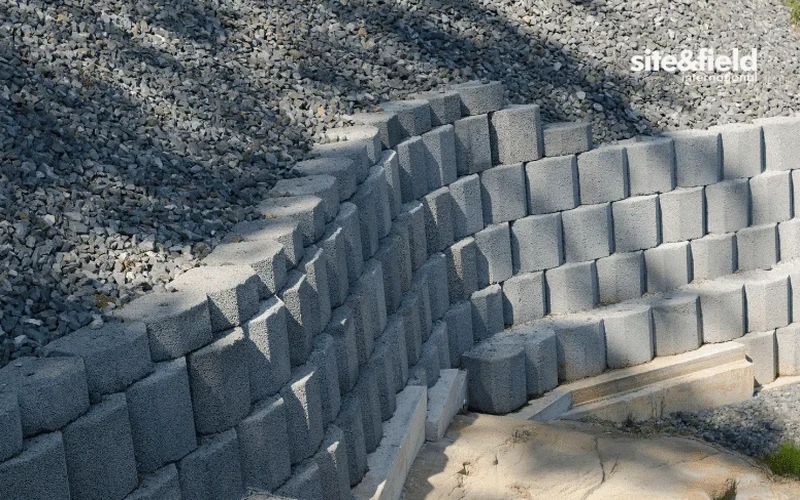
Local geotechnical conditions in Guelph
Guelph sits on the boundary between two physiographic regions — the Guelph Drumlin Field to the north and the gently undulating till plains to the south. This transition zone creates a particularly unpredictable subsurface for retaining wall construction. Drumlin cores of dense, overconsolidated till can transition within 20 meters to inter-drumlin swales filled with soft, compressible silt and organics. A wall designed for the dense till conditions will be dangerously under-designed if it unknowingly spans into a buried swale. The Speed and Eramosa river corridors add another layer of complexity: valley walls contain relict landslide debris and softened shale of the Queenston Formation where it outcrops near the river level. Groundwater levels in these corridors can fluctuate 2 meters seasonally, and rapid drawdown after spring melt is a documented trigger for retaining wall distress. We mitigate these risks through targeted subsurface investigation — not just boreholes at the wall alignment, but offset borings to map the till-bedrock interface and identify buried valleys. Cone penetration testing with pore pressure measurement helps delineate drainage boundaries. For walls over 3 meters retained height, we specify observational monitoring during excavation so that unexpected conditions trigger pre-planned contingency measures rather than emergency redesign.
Our services
Our retaining wall engineering practice in Guelph covers the full project lifecycle, from feasibility-level concept layouts through construction administration and post-construction monitoring. The three core service areas below reflect the range of wall types and site constraints we encounter across Wellington County.
Cantilever and Gravity Wall Design
Reinforced concrete cantilever walls and mass gravity walls for retained heights up to 6 meters. Includes bearing capacity checks on glacial till or bedrock, sliding and overturning stability per NBCC load combinations, and drainage design with granular backfill and weep holes. Typical for commercial site grading and residential lot development in Guelph's expanding south end.
Anchored and Tieback Wall Systems
Soldier pile and lagging walls with grouted tiebacks for deep excavations adjacent to existing buildings or roadways. Tiebacks are designed with bond lengths in competent dolostone or dense till, proof-tested to 133% of design load per CSA S6. We prepare staged excavation plans and monitor tieback load relaxation during the first 72 hours after stressing.
MSE Walls and Reinforced Soil Slopes
Mechanically stabilized earth walls using geogrid or steel strip reinforcement for highway embankments and approach fills. Design follows AASHTO LRFD methodology adapted to Ontario soils, with pullout resistance verified against site-specific friction angles from direct shear testing of the reinforced fill. Particularly cost-effective for walls exceeding 4 meters in open sites.
Common questions
What subsurface investigation is needed before designing a retaining wall in Guelph?
At minimum, one borehole per 20 meters of wall alignment, extending to a depth of at least 1.5 times the retained height below the base of the wall, or 3 meters into competent bedrock — whichever is deeper. We require standard penetration testing at 1.5-meter intervals, Shelby tube sampling of cohesive soils for triaxial testing, and groundwater monitoring wells if the wall is within 100 meters of the Speed or Eramosa rivers. Bedrock coring with RQD measurement is essential when tiebacks or footings will bear on the Guelph Formation.
What is the typical cost range for a retaining wall design in Guelph?
Do retaining walls in Guelph require a building permit?
Yes. The City of Guelph requires a building permit for retaining walls over 1 meter in height, or any retaining wall supporting a surcharge from a building or roadway. The permit application must include sealed engineering drawings, a geotechnical report, and a grading plan. Walls adjacent to property lines also require confirmation that the design does not adversely affect neighboring foundations or drainage patterns.
How do you account for frost action in Guelph retaining wall designs?
We extend the wall footing to at least 1.2 meters below finished grade, consistent with the Ontario Building Code frost penetration depth for the Guelph area. The backfill behind the stem is specified as free-draining granular material with less than 5 percent passing the 75-micron sieve, wrapped in a non-woven geotextile filter to prevent migration of native till fines. We also include a 150-millimeter-thick layer of closed-cell insulation board behind the upper 1.5 meters of the stem where the wall retains heated building interiors, to reduce the depth of frost penetration into the backfill.