Guelph sits at roughly 335 m elevation on the Guelph Drumlin field, where the overburden is a mix of glacial till, silt, and clay. These soils can lose strength fast when saturated. For warehouses on the east side or commercial builds near the Hanlon Expressway, conventional shallow footings often fall short on bearing capacity. We run the lab program that feeds a stone column design, measuring undrained shear strength and consolidation parameters before sizing the columns. The goal is load transfer through a compacted gravel column that drains and reinforces at the same time. For deeper silt pockets we pair the CPT test data with triaxial results to calibrate the vibro-replacement grid and verify settlement reduction targets under the NBCC 2020 serviceability limits.
A stone column grid converts loose silt into a composite ground mass with double the stiffness and a built-in drainage path.
Scope of work in Guelph
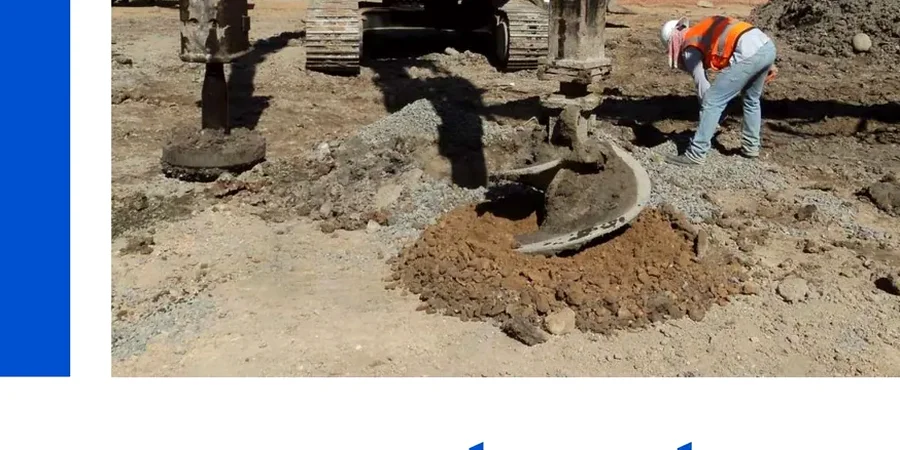
Live process video
Local geotechnical conditions in Guelph
Under NBCC 2020 Part 4, Guelph's silt units can trigger a site class E if the shear-wave velocity dips below 180 m/s in the upper 30 m. Skipping ground treatment on these profiles leads to differential settlement that cracks slab foundations and misaligns racking systems — a costly fix in food-processing facilities common around the city. Stone columns reduce total settlement by redistributing load to stiffer column-soil composite action. The bigger risk is underestimating the lateral confinement: without adequate overburden or a load-transfer platform, columns bulge near the surface and lose capacity. Our lab program quantifies the undrained shear strength profile so the column length and spacing maintain a factor of safety above 2.0 for bearing and 1.5 for settlement. We also check liquefaction susceptibility using SPT-based triggering curves from Youd and Idriss (2001) when the water table sits high in the spring.
Our services
We deliver the laboratory testing and design parameters that feed the stone column installation plan. Every report includes the shear strength envelope, consolidation curves, and column geometry recommendations.
Laboratory characterization for stone column design
We test host soil and column material: grain-size analysis, Atterberg limits, triaxial compression, and one-dimensional consolidation. Results define the replacement ratio, column spacing, and settlement reduction factor.
Post-installation verification testing
Once the vibro-replacement is done, we run in-situ density checks and load tests. Plate load tests on single columns and composite ground confirm the design bearing capacity and settlement compliance.
Common questions
What soil types in Guelph are suitable for stone columns?
The glacial till and silty clay deposits across the Guelph Drumlin field work well, provided the fines content stays under 15 percent for the dry bottom-feed method. We first run a grain-size analysis and Atterberg limits on Shelby tube samples to confirm suitability before committing to the column grid layout.
How much does a stone column design package cost in Guelph?
How long does it take to get design parameters from the lab?
Standard turnaround is three to four weeks. Consolidation tests need time for pore pressure dissipation in Guelph's silty clays, and triaxial staged shearing adds about a week. We can expedite sampling for an extra fee if the vibro-replacement rig is already on standby.
Which building code governs stone column design in Ontario?
The National Building Code of Canada 2020 Part 4 covers structural design and foundation requirements. For the reinforced ground, we reference FHWA-NHI-05 guidelines and CSA A23.3 for any concrete load-transfer platform placed above the columns.