Guelph sits on a complex mix of glacial till, outwash sands, and the infamous Guelph Formation dolostone. That means your tunnel alignment can shift from stiff clay to saturated silt in less than 50 meters. We've seen it. When a contractor hits a lens of water-bearing sand under Speedvale Avenue, the schedule blows out and the budget follows. Our geotechnical analysis for soft soil tunnels maps those transitions before the TBM ever enters the ground, giving you a clear picture of face stability and groundwater control for every chainage. Pairing this with CPT testing delivers a near-continuous soil profile, letting our engineers pinpoint exactly where conditioning needs to change.
In Guelph's glacial geology, the distance between a stable face and a running ground condition is often less than one tunnel diameter.
Scope of work in Guelph
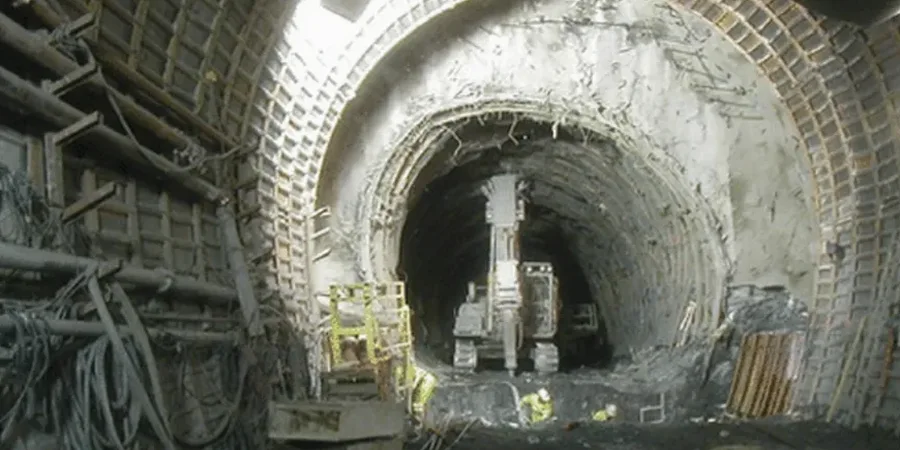
Local geotechnical conditions in Guelph
Guelph's population has grown over 10% since 2016, pushing infrastructure into marginal ground near the Speed and Eramosa rivers. At 334 meters above sea level, the city's variable overburden thickness creates a serious risk: tunneling under low cover with high groundwater. The 2014 Grand River watershed flood study showed how quickly water levels spike after a spring melt. In soft ground, that means a sudden loss of effective stress, a blowout, or a sinkhole on Norfolk Street. Our geotechnical analysis for soft soil tunnels quantifies this risk. We model pore pressure scenarios and prescribe face pressure limits that keep the crown stable even when the river levels jump. Ignoring these local hydrogeological quirks isn't a gamble worth taking.
Our services
Every tunnel project in Guelph's soft ground requires a specific set of supporting investigations. These are the two services our clients combine most often.
TBM Conditioning and Face Stability
We design the slurry or EPB conditioning parameters that match Guelph's silty clays. Includes laboratory foam testing and real-time field adjustments to keep your advance rate steady.
Settlement Risk Assessment
Predicting surface settlement is mandatory under any Guelph right-of-way. We provide Gaussian curve predictions and instrumentation plans to protect adjacent utilities and buildings.
Common questions
How deep are the soft soil deposits typically found in Guelph?
The overburden varies significantly. In the downtown core, you might find 15 to 25 meters of glacial till and outwash before hitting the Guelph Formation bedrock. Near the river valleys, the soft alluvial deposits can extend 10 to 18 meters deep, directly overlying the dolostone.
What is the typical cost range for a geotechnical analysis for soft soil tunnels in Guelph?
Can you perform the analysis if the tunnel is already partially excavated?
Absolutely. We frequently step into projects where the initial ground conditions didn't match the baseline report. We'll remap the face using rapid CPT soundings and lab tests on the excavated material, then provide a revised set of conditioning and support parameters within a short turnaround.
How do you handle groundwater during the analysis phase?
We install vibrating wire piezometers at multiple depths along the alignment. This gives us a real-time profile of the phreatic surface and any perched water tables, which is critical for calculating effective face pressure and preventing blowouts in Guelph's more permeable outwash sands.