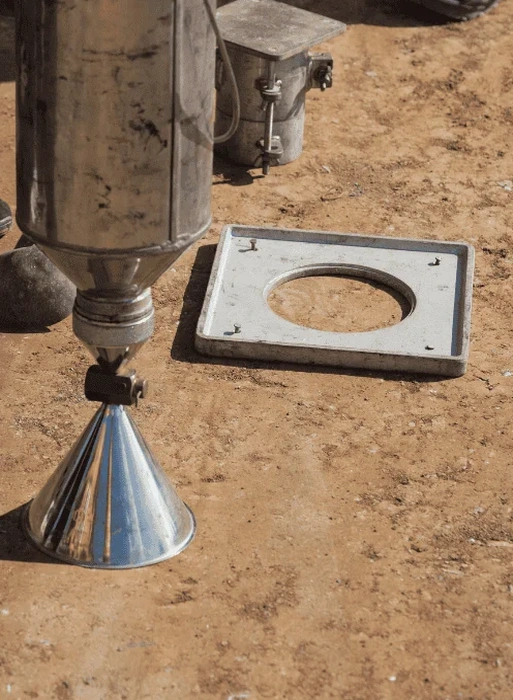
ASTM D1556 defines the standard for field density determination using the sand cone apparatus, and in Guelph, this test carries specific weight given the regional geology. The city sits atop the Guelph Formation—dolostone bedrock overlain by glacial till and glaciolacustrine deposits that vary dramatically across short distances. Compaction control in these heterogeneous soils cannot rely on guesswork. Whether placing engineered fill beneath a slab-on-grade near the Hanlon Expressway corridor or backfilling a sewer trench in the Junction neighborhood, the sand cone method provides direct, verifiable in-place density measurements that no nuclear gauge can match for accuracy in granular materials containing coarse fragments. Our laboratory runs calibrated Ottawa sand through ASTM C136-sieved cones, delivering results that contractors and geotechnical engineers in Guelph trust for municipal acceptance and consultant sign-off. For deeper compaction verification where SPT correlations are needed, we complement field density testing with SPT drilling to establish a complete subsurface performance profile.
Direct volume measurement with calibrated Ottawa sand eliminates the moisture and surface-roughness errors that skew nuclear gauge readings in Guelph's coarse glacial tills.
Scope of work in Guelph
Live process video
Local geotechnical conditions in Guelph
Guelph's development pattern stretches across the Paris-Galt moraine complex, where buried valleys filled with soft compressible silts lie hidden beneath a veneer of stiffer till. Early subdivisions from the 1960s through 1980s pushed into these marginal areas, and today's infill projects often encounter undocumented fill of highly variable quality. Compacting structural backfill over these legacy deposits without verified field density control invites differential settlement that cracks foundations and separates utility connections. A density test that reads 95% in one corner and 88% three meters away signals a problem before the concrete is poured. The sand cone method exposes these inconsistencies because it measures a discrete hole volume rather than averaging across a nuclear gauge's zone of influence. In Guelph's silty clay tills, achieving uniform compaction requires moisture conditioning within ±2% of optimum—a narrow window that field density verification enforces. Municipal inspectors across Wellington County increasingly require sand cone results for trench reinstatement acceptance, particularly where road settlement over backfilled cuts has been a recurring maintenance issue.
Our services
Our Guelph field services cover the full compaction verification workflow, from laboratory Proctor reference curves to on-site sand cone execution with same-day reporting. Each service follows Ontario Provincial Standard Specifications and ASTM protocols.
On-Site Sand Cone Density Testing
Complete field density determination per ASTM D1556 at your Guelph project site. Includes surface preparation, calibrated sand cone apparatus, hole excavation, moisture sample collection, and percent compaction calculation against the specified Proctor reference. Results delivered within 4 hours of testing.
Combined Proctor and Field Density Package
Laboratory Standard or Modified Proctor (ASTM D698/D1557) on project fill material paired with scheduled field density testing. This integrated approach ensures the reference curve matches the actual material being compacted—critical for Guelph's variable tills where borrowed fill may differ from the original lab sample.
Common questions
How much does a sand cone field density test cost in Guelph?
Which compaction standard applies for municipal road work in Guelph?
The City of Guelph references Ontario Provincial Standard Specification OPSS 501 for compaction requirements. Typically, 95% Standard Proctor density is required for subgrade under flexible pavement, while 98% applies to granular base course. Utility trench backfill often requires 95% to 98% depending on depth and pavement restoration requirements.
Why use the sand cone method instead of a nuclear density gauge?
The sand cone method measures volume directly by excavating and weighing the removed soil, while nuclear gauges infer density from radiation scatter. In Guelph's coarse glacial tills containing cobbles, the gauge's small measurement zone can miss large particles, producing unrepresentative readings. Sand cone also avoids regulatory requirements for radioactive source licensing, transport, and storage on site.
How long does it take to get results from a sand cone test?
Field density and moisture content are determined on site within 30 minutes for each test location. If the Proctor reference is already established, percent compaction is calculated immediately. When a companion moisture content sample requires laboratory oven drying per ASTM D2216, final dry density confirmation follows within 24 hours, though preliminary results are available same-day.