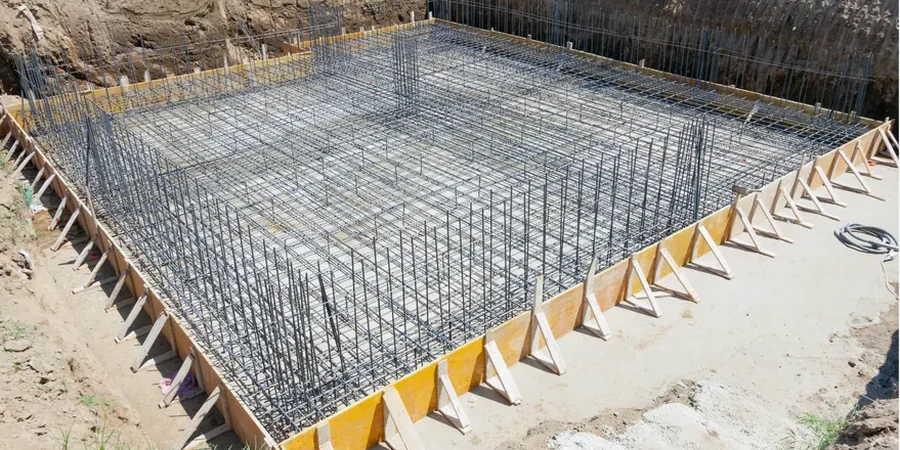
Guelph's geotechnical profile presents a classic southwestern Ontario challenge: stiff to very stiff glacial till overlying fractured dolostone of the Guelph Formation. Seasonal groundwater fluctuations within the till—often encountered between 3 and 7 meters depth—introduce shrink-swell potential that must be accommodated in foundation design. Raft or mat foundations distribute structural loads across a continuous slab, mitigating differential settlement in heterogeneous deposits where isolated footings would require excessive size or depth. In the city's downtown core, where mid-rise mixed-use buildings replace older structures on confined lots, the raft solution often becomes the only viable option to meet bearing capacity requirements while respecting property-line setbacks. A properly calibrated geotechnical model, built from site-specific SPT drilling data and laboratory consolidation tests, defines the modulus of subgrade reaction that drives the entire design. Our approach integrates field investigation, advanced soil-structure interaction modeling, and CSA A23.3 reinforced concrete detailing into a single cohesive deliverable.
A 40-meter raft on variable Guelph till can exhibit differential settlement under 12 mm when designed with a soil-structure interaction model calibrated to site-specific consolidation data.
Scope of work in Guelph
Local geotechnical conditions in Guelph
NBCC 2015 Part 4 and the referenced CSA A23.3 impose explicit requirements for foundations on compressible or variable ground, which applies directly to Guelph's till-dolostone transition zone. The most significant design risk is differential settlement arising from a dipping bedrock surface beneath a uniform-thickness raft; a condition frequently encountered on sites along the Eramosa River escarpment. Failure to detect a pinnacled or stepped rock profile during investigation can concentrate flexural stresses in the slab, leading to cracking and serviceability failure even when bearing capacity factors of safety appear adequate. A secondary risk involves long-term consolidation of saturated till lenses under sustained dead load, which our analysis addresses through Terzaghi one-dimensional consolidation theory calibrated to oedometer test results. We also evaluate frost heave potential in unheated perimeter areas—requiring a minimum 1.2-meter embedment depth per Ontario Building Code climate data for Guelph—and the need for underslab drainage when the groundwater table is within 1.5 meters of the underside of the raft.
Our services
Our Guelph raft/mat foundation scope extends from initial desktop assessment through construction-phase QA/QC. Each project is managed by a P.Eng.-stamped geotechnical report, supported by our in-house soils laboratory for index and consolidation testing.
Geotechnical Investigation for Raft Design
SPT boreholes, CPT soundings, and Shelby tube sampling to define till stratigraphy, groundwater regime, and consolidation parameters across the building footprint.
Soil-Structure Interaction Modeling
Finite element analysis (FEA) using Plaxis or SAFE to compute contact pressures, bending moments, and differential settlement under ULS and SLS load combinations.
Reinforced Concrete Detailing
Preparation of bending schedules, lap splice details, and punching shear verification at column interfaces in accordance with CSA A23.3, sealed by a licensed structural engineer.
Construction-Phase Inspection
Subgrade proof-rolling, reinforcement placement review, concrete slump and cylinder testing, and post-pour elevation surveys to confirm compliance with design assumptions.
Common questions
How much does a raft/mat foundation design cost for a typical Guelph project?
When is a raft foundation preferable to isolated footings in Guelph's soil conditions?
Rafts become the preferred solution when the allowable bearing pressure of the near-surface till is below 150 kPa, when the total footing area would exceed 50% of the building footprint, or when the bedrock surface is highly irregular and could cause differential settlement under isolated footings. They also provide inherent resistance to lateral soil movements in the expansive clay zones mapped in parts of south Guelph.
What geotechnical parameters are critical for the raft thickness calculation?
The coefficient of subgrade reaction (kv) is the primary input—it defines the soil's stiffness as an elastic spring support. We derive kv from plate load tests or from SPT N60 correlations corrected for overburden pressure. Equally important are the consolidation parameters (Cc, Cr, and preconsolidation pressure) obtained from oedometer tests on undisturbed Shelby tube samples of the till, which govern the long-term settlement component that must remain within NBCC serviceability limits.