The contrast between the shallow limestone bedrock near the Eramosa River and the deep, reddish Halton Till deposits in Guelph's east end dictates everything about foundation performance here. A silty clay from the west side can behave completely differently than a lean clay from the south end, even when both look similar in a hand sample. That difference is quantified by Atterberg limits. The liquid limit, plastic limit, and plasticity index tell us how much water the soil can hold before it turns from a solid into a plastic putty, and eventually into a liquid slurry. For builders working on sites along Speedvale Avenue or near the University of Guelph, skipping this test means guessing at the shrink-swell potential of the native ground. We run these tests alongside grain size analysis when the fines content exceeds 50%, giving a complete picture of the soil's classification and its expected behavior under fluctuating moisture conditions that are common in southwestern Ontario's freeze-thaw cycles.
A plasticity index shift of just 10 points in Guelph's glacial till can change the site classification from low to high expansion potential, completely altering the foundation design.
Scope of work in Guelph
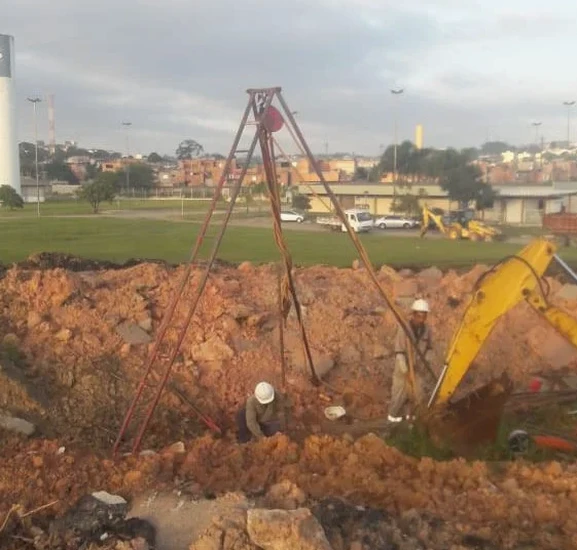
Local geotechnical conditions in Guelph
The lab bench for Atterberg limits looks deceptively simple: a brass cup, a grooving tool, a glass plate, and an oven. But there is a lot of judgment involved. The technician in Guelph has to adjust the water content incrementally, working with local till that often contains small pebbles which must be removed without altering the fines fraction. The biggest risk for a project is not that the test is skipped entirely, but that it is performed poorly. A liquid limit determined from just two points on the flow curve can be off by 5 to 8 percentage points. In a Guelph subdivision where the geotechnical report specifies a bearing capacity based on a CL classification, that error can lead to under-designed footings. We see this most often with infill lots where the developer assumes the soil is identical to the neighboring property. It rarely is. A single unmarked pocket of high-plasticity clay from an old ponded depression can cause differential heave that cracks foundation walls. Running Atterberg limits on every distinct layer encountered in the borehole log eliminates that guesswork.
Our services
Our Atterberg limits testing in Guelph is part of a broader geotechnical characterization that connects index properties to foundation performance. Each of these services addresses a specific question about the ground.
Multi-Point Liquid Limit
Full Casagrande method with 4+ data points on the flow curve, plotted on semi-log scale. Required for accurate USCS classification of Guelph's silty clays.
Plastic Limit by Hand Rolling
Thread-rolling method per ASTM D4318. Critical for distinguishing silts from clays in the Halton Till matrix where visual classification is unreliable.
Plasticity Index Calculation
PI = LL - PL. This single number drives the expansion potential assessment and correlates directly with the clay mineral activity in the Paris Moraine deposits.
USCS Classification Package
Combined Atterberg limits and grain size analysis to assign a full USCS symbol (CL, CH, MH, etc.) for foundation design, earthworks, and pavement subgrade evaluation.
Common questions
How much does Atterberg limits testing cost in Guelph?
Why do Guelph soils need Atterberg limits rather than just a pocket penetrometer reading?
A pocket penetrometer gives an unconfined compressive strength estimate but tells you nothing about how the soil will behave when it gets wet. Guelph's Halton Till contains enough smectite in some layers to produce a plasticity index over 30, which signals high shrink-swell potential. That clay can pass a pocket penetrometer test when dry and still heave enough to crack a foundation.
How long does the test take from sample to report?
The oven drying alone takes 24 hours to reach constant mass. After that, the liquid limit and plastic limit procedures take about 3 to 4 hours of technician time. We typically deliver the report within 3 to 5 business days. Rush turnaround is available for active construction sites.
Can you run Atterberg limits on samples we have already collected?
Yes, as long as the samples have been kept in sealed containers to preserve the natural moisture content. We need roughly 300 grams of material passing the No. 40 sieve. If the sample has dried out, we can still run the tests but it must be noted on the report that the results represent remolded conditions, not in-situ moisture.
What is the difference between Atterberg limits and a hydrometer test?
Atterberg limits measure how the fine fraction of the soil behaves with changing water content, giving us the liquid limit, plastic limit, and plasticity index. A hydrometer test measures the particle size distribution within the silt and clay range. In Guelph's tills, we often run both because a high clay percentage on the hydrometer should correspond to a high plasticity index. If it does not, that suggests the clay minerals are kaolinite rather than smectite, which is a much more stable material for foundations.