The truck-mounted CPT rig rolls onto the site near the Speed River, its hydraulic rams pressing a 15 cm² cone at a steady 2 cm per second into the Guelph Formation dolostone overburden. You can feel the resistance data flowing in real time; that sudden spike at 4.2 meters tells you exactly where competent bedrock begins. In Guelph, shallow foundation design is rarely about finding rock, it is about determining how much of the weathered, fractured upper horizon must be removed before a spread footing can safely transfer column loads. The city’s drumlin fields and outwash plains create a patchwork of silty tills and sandy lenses that shift bearing behavior within a single building footprint. We combine cone penetration data with laboratory classification to dimension footings that stay within NBCC 2020 allowable settlements, avoiding the costly over-excavation that inexperienced designers often specify here. For sites where the glacial stratigraphy is particularly erratic, a targeted CPT test campaign provides the continuous stratigraphic profile needed to pinpoint the optimal bearing stratum without guesswork.
In Guelph’s glacial terrain, the difference between a 1.5-meter and a 2.2-meter footing depth is not cost; it is the line between negligible settlement and a decade of serviceability complaints.
Scope of work in Guelph
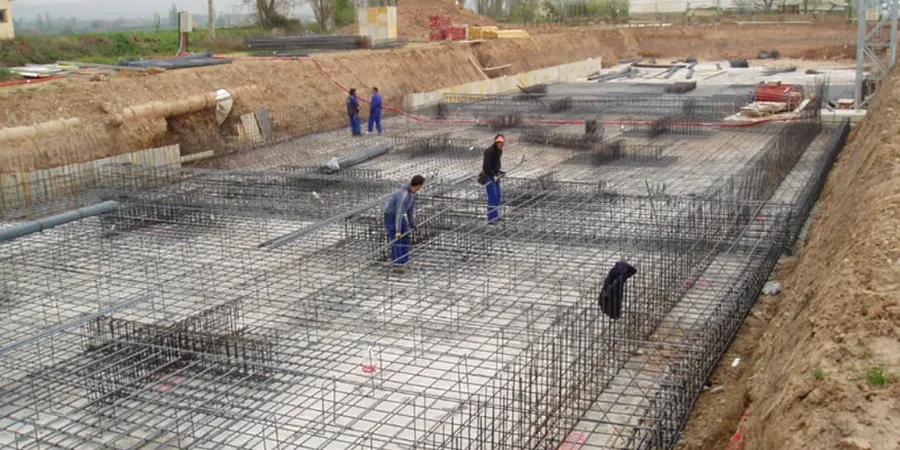
Local geotechnical conditions in Guelph
With a population of roughly 144,000 and a built environment that mixes 19th-century limestone structures with modern mid-rise concrete, Guelph carries a legacy of foundation performance data spanning over 150 years. The most recurrent failure mode in the city’s shallow foundations is not catastrophic bearing collapse but differential settlement between adjacent footings founded on dissimilar materials, a condition we see frequently at the transition zone where the dolostone bedrock pinches out beneath a single building footprint. The 2014 Guelph City Hall expansion, for example, required careful underpinning design when the excavation revealed a 3-meter vertical step in the rockhead across just 12 meters of plan length. A less rigorous shallow foundation design would have placed one corner on rock and the other on compressible till, almost guaranteeing angular distortion exceeding 1/500 and cracking in the superstructure. We address this risk upfront by specifying structural slab transitions, deepened keyways into competent rock, or localized geogrid reinforcement of the till subgrade to bridge the stiffness contrast before the footings are cast.
Our services
Our shallow foundation design work in Guelph covers the full lifecycle from geotechnical investigation through construction review. We provide dimensioned footing plans, reinforcement schedules, and settlement monitoring protocols.
Spread Footing Design and Optimization
We calculate bearing capacity using the general shear failure equation (Terzaghi, Meyerhof, or Vesic) with site-specific shear strength parameters from triaxial or direct shear testing on Guelph Formation soils. Each footing is optimized for plan dimensions and embedment depth to minimize concrete volume while meeting NBCC 2020 serviceability limits for total and differential settlement.
Raft and Mat Foundation Analysis
For structures on the compressible Halton Till or where bedrock is highly irregular, we model soil-structure interaction using finite element methods to design rigid or flexible mat foundations. The analysis incorporates the coefficient of subgrade reaction derived from plate load tests or back-calculated from the constrained modulus, ensuring uniform settlement distribution across the slab.
Common questions
What is the typical cost range for a shallow foundation design for a single-family home in Guelph?
How do you determine if a shallow foundation is feasible on my Guelph property?
We start with a desktop review of the Ontario Geological Survey surficial geology maps to identify the expected drift unit on your site, then proceed with a site investigation combining test pits or solid-stem auger boreholes with in-situ SPT or CPT testing. The feasibility of a shallow foundation hinges on three factors: the presence of competent bearing material within 2-3 meters of grade, groundwater table depth relative to the footing invert, and the compressibility of any soils beneath the bearing stratum that could contribute to long-term settlement.
What is the difference between presumptive bearing values and a site-specific bearing capacity analysis?
Presumptive bearing values, such as those tabulated in NBCC 2020 for rock or dense till, are conservative defaults intended for preliminary sizing when no site investigation has been performed. A site-specific analysis, by contrast, uses measured shear strength parameters (friction angle and cohesion from triaxial or direct shear tests) and applies a bearing capacity equation to calculate the ultimate capacity, then divides by the code-required factor of safety. In Guelph, where the dolostone can vary from highly fractured to massive within a single excavation, a site-specific analysis often justifies a bearing pressure 30 to 50 percent higher than the presumptive value, yielding a more economical footing design.