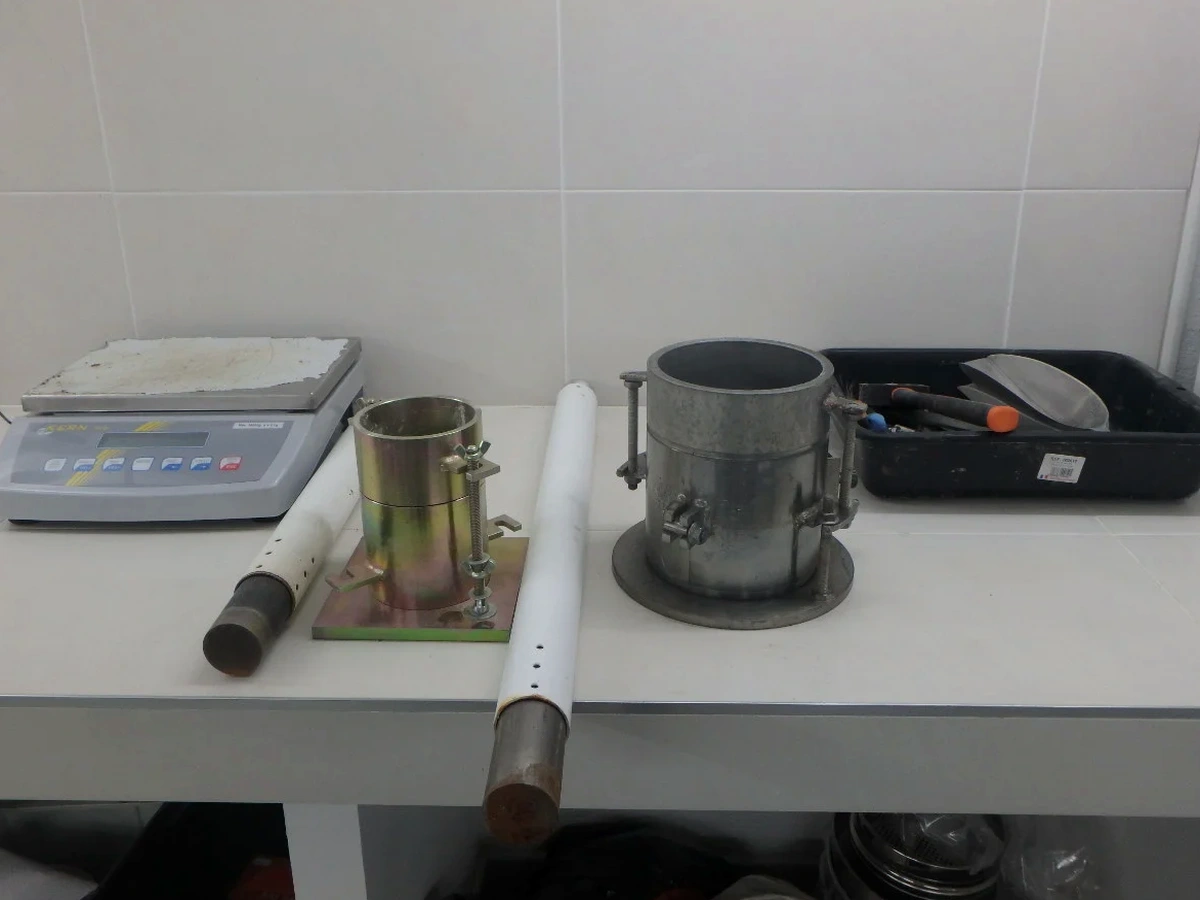
A townhouse development off Gordon Street last fall ran into trouble two weeks after backfilling the underground parking ramp. The compacted fill started settling unevenly, cracking the fresh asphalt base. When the site supervisor called us in, the first question was straightforward: what moisture-density relationship was used for compaction spec? Nobody had run a proper Proctor on the silty till excavated from the north end of the site. Guelph sits on a complex mantle of Port Stanley Till and glaciofluvial outwash, and assuming a generic maximum dry density is a gamble that typically loses. The Standard Proctor test (ASTM D698) establishes the baseline moisture-density curve for fine-grained fills, while the Modified Proctor (ASTM D1557) simulates heavier compaction effort for high-traffic subgrades. Pairing this with a grain size analysis tells you whether the native material will even respond to mechanical compaction in the first place.
A Proctor number without knowing the actual soil classification is just a number. The till in south Guelph behaves nothing like the outwash sand near the Speed River.
Scope of work in Guelph
Local geotechnical conditions in Guelph
Guelph's development pattern has pushed subdivision grading into areas where the natural ground is a patchwork of dense till, soft silt lenses, and buried organic layers from pre-settlement wetlands. The city's northwest expansion into former agricultural land east of the Hanlon Expressway has exposed fills that look uniform in the cut but vary wildly in compaction response. A single Proctor curve applied blanket-style across a 200-lot subdivision leads to under-compaction in silty zones and over-compaction in clay-rich pockets — both of which produce differential settlement that shows up as cracked basement slabs within five years. The Ontario Building Code references engineered fill specifications that assume Proctor-based quality control, and municipal inspectors in Guelph increasingly require laboratory moisture-density relationships before approving structural fill placement. Skipping the test on deep utility trench backfill under roadways is where we see the costliest failures.
Our services
The Proctor test alone does not address compaction challenges—it provides the foundation for a field quality control program. The following describes how we integrate complementary services for Guelph projects:
Standard Proctor (ASTM D698)
The baseline compaction test for residential fill, landscaping berms, and utility trench backfill where compaction equipment is lighter. Three-point curve with full moisture-density report.
Modified Proctor (ASTM D1557)
Higher compactive effort for commercial building pads, arterial road subgrades, and engineered structural fill under footings. Required when specs call for 95% or 98% Modified Proctor density.
Field Density Verification
Nuclear gauge or sand cone testing during fill placement to confirm that field dry density meets the percentage of Proctor maximum specified in the geotechnical report.
One-Point Proctor Correlation
A faster field check method used during active earthworks when material changes are suspected. Correlates a single compacted point to the established Proctor curve for rapid go/no-go decisions.
Common questions
How much does a Proctor test cost in Guelph?
When should I use Standard Proctor versus Modified Proctor?
Standard Proctor simulates the compaction effort of lighter rollers and rammers typical of residential construction and landscaping. Use it for townhouse pads, utility trenches, and non-structural fill. Modified Proctor replicates heavy vibratory rollers and is the right call for arterial road subgrades, commercial building pads, and any engineered fill where the spec calls for 95% or higher Modified density. In Guelph, most commercial projects in the Hanlon Creek and Clair Road corridors default to Modified Proctor.
How long does a Proctor test take from sample drop-off to report?
Standard turnaround is 3 to 5 business days for a full three-point Proctor curve. We can often deliver a one-point Proctor correlation within 24 hours if you need a quick field check during active earthworks. The limiting factor is drying time — Guelph's silty tills hold moisture stubbornly, and rushing the drying stage compromises the curve accuracy.
What sample size do I need to bring in for a Proctor test?
For a Standard Proctor, you'll need about 25 kg of representative material in a sealed bucket or heavy-duty bag. For Modified Proctor with oversize correction, plan on 35 to 40 kg. The sample should come from the actual fill lift being placed, not from a weathered stockpile surface. If the material contains particles larger than 3/4 inch, let the lab know upfront so we can run the oversize correction per ASTM D4718 rather than reporting uncorrected numbers that will mislead compaction targets.