In Guelph’s evolving urban and suburban landscape, the integrity of slope stability and retaining structures is fundamental to safe, lasting development. The Slopes & Walls category encompasses the geotechnical analysis, design, and reinforcement of natural and engineered earth profiles to resist failure and manage lateral soil pressures. Whether stabilizing a creek valley in the Eramosa River corridor or supporting a deep excavation near downtown, these services address the critical interface between soil, rock, water, and structural elements. In a city carved by glacial spillways and underlain by complex overburden, neglecting slope and wall engineering invites costly failures, regulatory delays, and long-term liability.
Guelph’s geology is dominated by the Guelph Formation—dolostone bedrock typically encountered at variable depths beneath a mantle of glacial till, silty clay, and sand lenses. These deposits, shaped by the Paris and Galt Moraines, create locally unstable conditions: stiff clay layers can soften at the surface, while granular seams act as conduits for groundwater, elevating pore-water pressures on slopes and behind walls. Seasonal freeze–thaw cycles and heavy spring melt further degrade near-surface soils, triggering shallow slumps and erosion. Deep foundations and anchored systems must often contend with pinnacled bedrock surfaces where dolostone can transition abruptly from competent to highly weathered within metres, demanding careful site characterization before any retaining wall design begins.
All slope and wall works in Ontario must comply with the Ontario Building Code (OBC), which references the National Building Code of Canada and mandates geotechnical input for excavations, foundations, and earth retention. The Professional Engineers Ontario (PEO) guidelines and the Canadian Foundation Engineering Manual (CFEM) set the standard of practice, while municipal approvals in Guelph require reports sealed by a licensed geotechnical engineer. For post-construction performance, the Canadian Highway Bridge Design Code (CHBDC) and MTO standards often inform durability and loading criteria even on private projects. Adherence to these documents ensures designs meet ultimate and serviceability limit states under local seismic, hydraulic, and surcharge conditions.
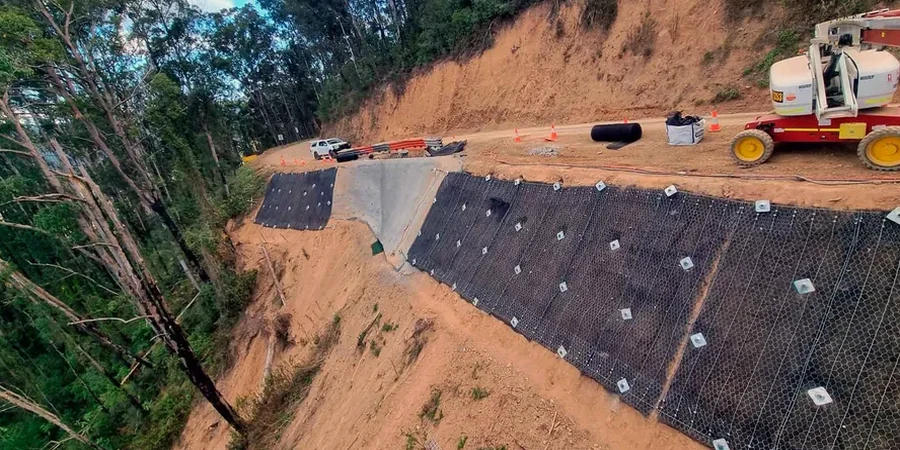
Projects requiring our Slopes & Walls expertise range from residential infill lots where steep backyard cuts demand compact retaining walls, to institutional expansions on the University of Guelph campus where deep excavations must protect adjacent heritage buildings. Infrastructure upgrades—such as bridge abutments along the Hanlon Expressway, stormwater pond embankments, or trail realignments in Preservation Park—rely on robust slope stability analysis to prevent rotational or translational failures. Where space constraints rule out massive gravity walls, we deploy active/passive anchor design to tie back soldier piles or diaphragm walls, transferring loads into competent bedrock or dense till. Each solution is calibrated to Guelph’s subsurface variability and the project’s temporary and permanent loading scenarios.
Common questions
What factors most influence slope stability in Guelph?
Local factors include the thickness and composition of glacial till over dolostone bedrock, groundwater seepage through sand lenses, and seasonal moisture fluctuations. Steep valley walls along the Speed and Eramosa Rivers are susceptible to toe erosion and shallow slumping. Proper analysis requires site-specific shear strength testing, pore-water pressure measurement, and consideration of freeze–thaw effects on near-surface soils.
When is a retaining wall required instead of a graded slope?
A retaining wall becomes necessary when space constraints, property boundaries, or existing structures prevent a stable open slope, or when a cut exceeds the allowable height for the soil type. Walls are also used to protect waterways, support road widenings, and create usable terraces on steep residential lots. The choice depends on geotechnical conditions, surcharge loads, and long-term maintenance requirements.
What role do anchors play in deep excavation support?
Anchors transfer tensile loads from a retaining wall face into competent soil or bedrock beyond the active failure zone. In Guelph’s till and dolostone, both active prestressed anchors and passive grouted bars are used to brace soldier pile and lagging walls, secant pile walls, or diaphragm walls. They minimize internal bracing, open up work space, and are critical where adjacent structures limit allowable movement.
What are the typical regulatory requirements for slope and wall designs in Ontario?
Designs must follow the Ontario Building Code and accepted geotechnical standards such as the CFEM. A Professional Engineer licensed by PEO must prepare and seal the design report. For public works, MTO or municipal standards may apply. The City of Guelph requires submission of a geotechnical report addressing stability, drainage, and construction impact as part of site plan or building permit applications.