Guelph sits at roughly 334 metres above sea level, straddling a complex boundary between glacial till plains and the underlying Guelph Formation dolostone. Over 144,000 people live here, and the city is growing into areas where the overburden thickness can vary from 2 to over 30 metres within a single block. Getting reliable subsurface data is not optional. The Standard Penetration Test (SPT) is the workhorse we deploy to quantify that variability. We run SPT in Guelph according to ASTM D1586, using automatic trip hammers calibrated for energy efficiency. When the site investigation reveals soft silty clay lenses within the till, we often pair the SPT program with triaxial testing to define the undrained shear strength for bearing capacity analysis. The SPT also flags the top of rock reliably, which is critical where the dolostone surface is pinnacled and irregular—a signature of the Guelph Formation that surprises many owners during excavation.
An SPT N-value corrected to N60 is the single most cost-effective data point for designing shallow foundations on Guelph’s heterogeneous glacial till.
Scope of work in Guelph
Local geotechnical conditions in Guelph
The Ontario Building Code (OBC 2012, Section 4.2) and the referenced NBCC require site-specific geotechnical data for foundations. In Guelph, skipping SPT investigation carries specific risks: encountering buried bedrock valleys filled with compressible organic silt that cause differential settlement, or misidentifying a stiff clay as bearing stratum when it’s underlain by loose saturated sand prone to liquefaction. On the University of Guelph campus and surrounding neighbourhoods, we’ve logged peat and marl pockets within the till that are invisible from the surface. Without SPT refusal at the rockhead, a shallow footing might bear on a thin limestone ledge over a solution cavity—a feature common in the Amabel dolostone member. The SPT provides the stratigraphic control to catch these transitions before they become structural failures. It is the baseline test required to justify any reduction in the geotechnical resistance factor for ultimate limit state design.
Our services
Our SPT service in Guelph is structured around three core deliverables that take a project from preliminary design to final ground improvement decisions.
Borehole SPT Drilling
Truck-mounted or track-mounted auger drilling with automatic hammer SPT at 1.5 m intervals. We handle residential additions in Old University area and commercial builds near the Hanlon Expressway, with full OBC-compliant logging and N60 profiles.
Liquefaction Screening
For sites near the Speed and Eramosa River corridors, we assess cyclic resistance ratio (CRR) from SPT blow counts per Youd & Idriss. This includes fines content adjustment and post-liquefaction settlement estimates for foundation performance.
Rockhead Confirmation
Where the Guelph Formation dolostone is shallow, we track SPT refusal and core the first 1.5 m of rock to confirm RQD and recovery. This is paired with N-value profiles to design end-bearing piles socketed into competent limestone.
Common questions
How much does an SPT borehole cost in Guelph?
How deep do you drill SPT boreholes in Guelph?
Most residential and light commercial projects require 8 to 15 metres. The depth is governed by the OBC requirement to investigate to a depth where the stress increase is less than 10% of the overburden pressure. For taller structures near downtown Guelph, we may go to 20 m or until refusal on competent dolostone.
What type of hammer do you use for the SPT?
We use an automatic safety hammer with an energy transfer ratio calibrated to approximately 70-75%. The raw N-value is corrected to N60 using the measured energy ratio. This is superior to the older rope-and-cathead systems still seen on some rigs and ensures the data is reproducible for foundation design.
Can you perform SPT in basements or tight access sites in Guelph?
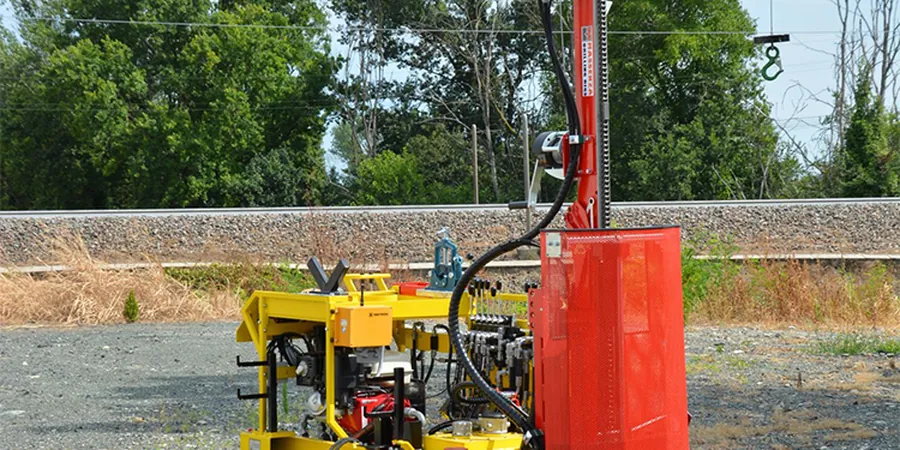
Yes. For confined-access sites—such as additions to century homes in the Exhibition Park neighbourhood or mechanical room retrofits—we deploy a compact track-mounted drill that can pass through a standard 36-inch doorway. The SPT is run with the same ASTM D1586 procedure, though the drilling rate may be slower due to manual rod handling.