Designing an anchor system in Guelph’s south end near the Speed River floodplain is a different challenge than anchoring into the shallow dolostone of the city’s east side. The river corridor often presents 3 to 5 meters of soft organic silt and saturated fine sand before hitting competent till. On the limestone plain, refusal can come at less than 2 meters. These contrasts demand an understanding of local stratigraphy that comes only from drilling across the city. We combine data from test pits in accessible areas with bedrock probing to define the bond length before selecting a post-tensioning strategy. Whether the load is 200 kN for a temporary shoring wall or over 1,000 kN for a permanent bridge abutment, the anchor type—active or passive—must match the deformation tolerance of the structure and the stiffness of the Guelph formation underneath.
Bond stress in fractured Guelph dolostone is cut by 60% compared to intact rock—site-specific pull-out tests are non-negotiable before production drilling.
Scope of work in Guelph
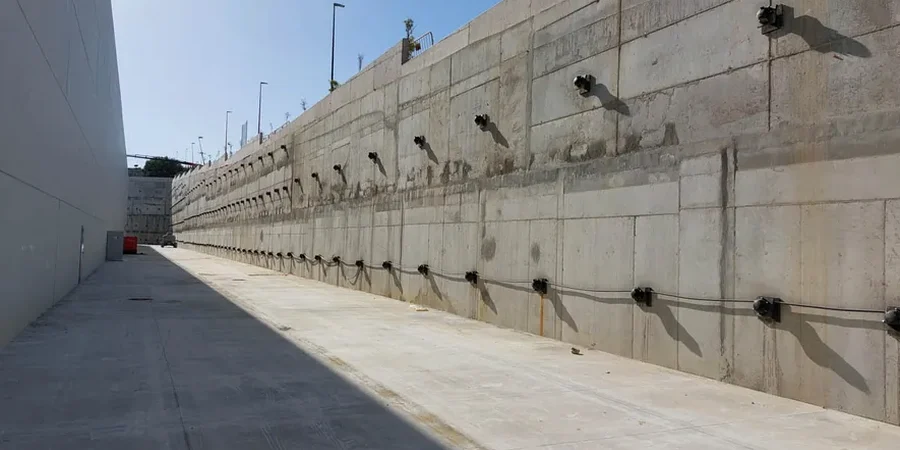
Local geotechnical conditions in Guelph
The drilling rig is a Klemm 806 with a rotary-percussive head, running 6-inch casing through overburden before switching to a down-the-hole hammer for the dolostone. In Guelph, the biggest risk is not the rock—it’s the transition zone. When the casing hits a boulder in the till, the driller can mistake it for bedrock, set the bond length too high, and leave the tendon vulnerable to creep failure when the soil below consolidates. We prevent this with real-time drilling parameter monitoring. Penetration rate, torque, and flush pressure are logged every 10 centimeters. A sudden drop in torque with a spike in penetration rate signals the true top of rock. Without this data, an anchor can pass the short-term proof test and still fail in service. A second risk is long-term corrosion in the seasonally wet, slightly acidic soils near the Eramosa River. Passive anchors here get fully encapsulated Class II protection, even when technically Class I would suffice, because the replacement cost of a failed anchor under an occupied structure is untenable.
Our services
Anchor design in Guelph requires more than a spreadsheet calculation. The variable depth to bedrock, the presence of fractured zones within the dolostone, and the high seasonal groundwater all influence the bond length, the corrosion protection level, and the testing protocol. Below are the anchor services we provide across the region, each tailored to the subsurface conditions we encounter in Wellington County.
Temporary Tieback Anchors for Excavation Support
Design and load testing of active, restressable anchors for soldier pile and lagging walls in downtown Guelph. We handle the full submittal package including unbonded length calculations, bond zone verification in till or rock, and 133% proof testing with digital load-displacement logging.
Permanent Rock Anchors for Infrastructure
Double-corrosion-protected tendon design for bridge abutments, retaining walls, and dam tie-downs. Bond lengths are confirmed by water pressure testing in the Guelph Formation to identify open joints, and lock-off loads are specified to offset long-term relaxation.
Passive Anchor (Rock Bolt) Design in Dolostone
Fully grouted, untensioned anchors for shallow rock slope stabilization and foundation tie-downs. We specify bar type (Grade 75 or 100), grout mix for sulfate-resistant performance, and acceptance criteria based on pull-out tests to 150% of working load.
Anchor Load Testing and Remedial Design
Diagnostic load testing of existing anchors using hydraulic jacks with electronic displacement transducers. When anchors fail the creep test, we design replacement or supplementary anchors, often converting a passive system to an active one to limit further movement.
Common questions
What is the difference between an active and a passive anchor?
An active anchor is tensioned to a specified lock-off load immediately after installation—it actively applies a compressive force to the structure. A passive anchor is fully grouted but not post-tensioned; it only develops resistance when the ground or structure moves enough to mobilize the tendon. In Guelph, we use active anchors for excavation support where deformation must be controlled from day one, and passive anchors for rock slope stabilization where small movements are acceptable.
How deep do anchors need to go in Guelph's soil and rock?
It depends entirely on the depth to competent bedrock and the required bond length. In areas where the Guelph Formation dolostone is at 2 meters, a total anchor length of 8 to 10 meters may suffice. Where there is 8 meters of till over rock, total lengths can exceed 18 meters. The unbonded length must extend beyond the theoretical failure plane, and the bond length is calculated based on the allowable grout-to-ground bond stress for the specific material—till, shale, or dolostone—encountered at that location.
How much does anchor design and installation cost in Guelph?
What testing is required for ground anchors under CSA A23.3?
CSA A23.3 Annex D mandates three types of tests. Performance tests confirm the design bond capacity—these go to 133% of the design load and measure creep. Proof tests verify every production anchor’s capacity at the same load level. Extended creep tests are required for permanent anchors in soils where the bond zone is in a compressible material. In Guelph, any anchor bonded in glacial till above the water table gets an extended creep test because of the potential for consolidation under sustained load.