Guelph sits at 334 m elevation on a complex drumlin field, where glacial till dominates the near-surface geology. The city’s 144,000 residents depend on roads built over silty clay tills that can lose strength fast when saturated. This is where the laboratory CBR test becomes essential. We run soaked CBR specimens per ASTM D1883 to simulate worst-case subgrade conditions after spring melt. For flexible pavement design on the city’s north-end industrial expansions, we pair the CBR road test with index property verification on the same sample. Over 60% of Guelph’s subgrades classify as low-plasticity silt, and without proper CBR data, the pavement structure is just guesswork. We deliver results in three business days.
A soaked CBR below 3% means the subgrade will pump fines under traffic load. We see this often in Guelph’s eastern clay plains.
Scope of work in Guelph
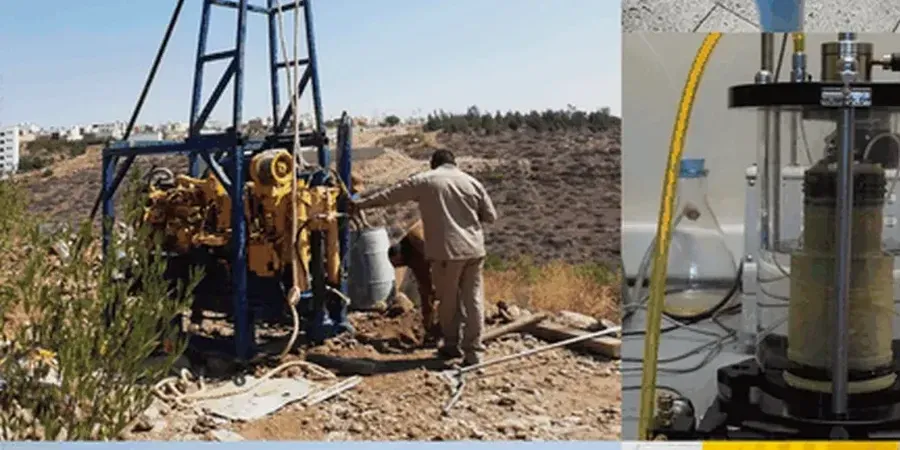
Local geotechnical conditions in Guelph
A common observation from Guelph projects: contractors skip the soaked CBR test, design with unsoaked values, and two years later the asphalt shows alligator cracking along the wheel paths. The culprit is always the same. Guelph’s silty till matrix holds capillary moisture through winter, and the spring thaw saturates the upper 300 mm of subgrade. A CBR of 12% unsoaked can drop to 4% soaked. That difference means a pavement section designed for 500,000 ESALs fails at 150,000. We recommend running the test on both natural and stabilized specimens so the design engineer can quantify the benefit of lime or cement treatment. The cost of a failed arterial road in Guelph’s east end far exceeds the cost of the laboratory CBR test.
Our services
We deliver laboratory CBR testing embedded within a broader geotechnical workflow. Each service targets a specific question the pavement designer needs answered.
Soaked CBR with index property package
One-point compaction to verify field density, 96-hour soak, penetration test, plus Atterberg limits and grain-size distribution from the same sample. We report the CBR value at both 2.54 mm and 5.08 mm penetration, corrected for concavity if needed. This package covers the Ontario Ministry of Transportation's minimum requirements for municipal road tenders in Guelph.
CBR on cement-stabilized Guelph till
Specimens mixed with 3% to 6% Portland cement by dry mass, compacted at optimum moisture, cured for 7 days in a humidity room, then soaked and penetrated. We report the strength gain ratio versus untreated material so the engineer can justify the stabilization line item in the tender package. This test is mandatory for Guelph subdivisions built on low-CBR native till.
Common questions
What does a laboratory CBR test cost in Guelph?
How long does the CBR test take from sample drop-off to report?
Three business days for a standard soaked CBR. The 96-hour soak drives the timeline. If you need results faster, we can run an unsoaked preliminary value in 24 hours, but the soaked value is what governs Guelph pavement design under the Ontario Building Code.
Do I need a CBR test if I already have grain-size data?
Yes. Grain-size tells you the soil classification, not its strength after compaction and saturation. Two Guelph tills with identical silt content can show CBR values differing by a factor of two depending on clay mineralogy and compaction moisture. The CBR test measures a mechanical response that grain-size curves cannot predict.