The city of Guelph sits perched on the Paris-Galt Moraine, a legacy of the last glaciation that left behind a chaotic mix of dense till, sand and gravel lenses, and compressible silts within the first 20 to 30 metres. When we mobilize the CPT rig to a site in the Royal City, we are rarely dealing with a predictable layer cake — more often it is a rapid alternation of materials that conventional boreholes can mischaracterize. The cone penetration test resolves this by measuring tip resistance (qc), sleeve friction (fs), and dynamic pore pressure (u2) every few centimetres, giving us a near-continuous log of soil behaviour type without the disturbance introduced by drilling. In our experience on Speed River floodplain sites and the higher drumlin topography north of Stone Road, this data proves decisive for identifying thin drainage layers that control consolidation rate and for flagging loose zones that might otherwise be missed.
A CPT profile through the Paris-Galt Moraine typically captures more stratigraphic decisions per metre than any other single investigation method.
Scope of work in Guelph
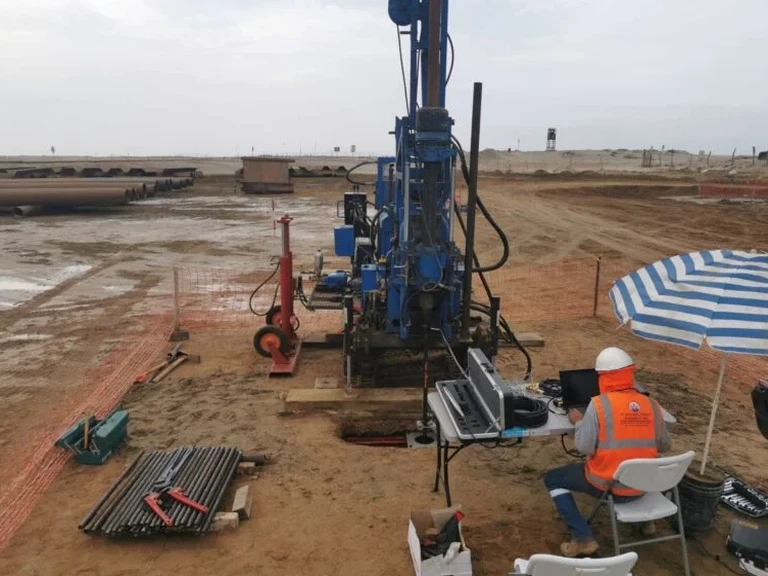
Local geotechnical conditions in Guelph
One recurring mistake we see on Guelph projects is relying solely on N-value correlations from split-spoon samples taken every 1.5 metres to characterize a site where the stratigraphy changes within half that distance. The cone penetrometer traverses these transitions without interruption, and when a thin silt seam at 9 metres depth goes undetected by a conventional borehole, the result can be a foundation settlement calculation that underestimates total compression by 30 percent or more. Even worse, a missed loose sand lens below the water table in the Catfish Creek formation can fail the state-of-practice liquefaction screening, leaving a mid-rise building with a residual risk that neither the geotechnical report nor the structural design has addressed. On post-industrial lands near the Eramosa River, where fill thickness varies unpredictably, we have seen CPT refusal patterns that revealed buried concrete slabs and old foundations — hazards that drilling alone had failed to map.
Our services
Our CPT services in Guelph are structured around the specific ground conditions of the moraine and the data requirements of modern geotechnical design. Each module is configured to deliver the parameters that structural and environmental engineers actually need, without superfluous reporting.
Piezocone (CPTu) with Pore Pressure Dissipation
Full u2 measurement during penetration plus timed dissipation tests at critical horizons to estimate horizontal coefficient of consolidation (ch) for settlement rate analysis.
Seismic CPT (SCPTu)
Downhole shear wave velocity measurement integrated with the cone string, producing a continuous Vs profile for NBCC site classification without a separate borehole.
Liquefaction Screening & Triggering Analysis
Automated layer detection and cyclic stress ratio evaluation using the CPT-based simplified procedure per Boulanger & Idriss (2014), with LPI and LSN output.
Direct Foundation Parameter Derivation
Conversion of cone data to drained friction angle, undrained shear strength, constrained modulus, and modulus of subgrade reaction for shallow and deep foundation design.
Common questions
What depth can a CPT rig reach in Guelph's glacial soils?
In the overburden typical of the Paris-Galt Moraine, our 20-ton CPT truck consistently reaches 25 to 30 metres before encountering refusal on the Guelph Formation dolostone. Penetration depth is limited by cone tip stress capacity (typically 50 MPa) and rod buckling; in very dense lodgement till with qc exceeding 25 MPa, refusal may occur shallower, which is why we sometimes prebore through the upper crust to maintain depth capability.
How does CPT compare to SPT for seismic site classification under the NBCC?
The NBCC 2020 permits site classification using shear wave velocity (Vs) directly, which we obtain from seismic CPT without the disturbance and depth-averaging inherent in the SPT-N method. On Guelph sites with interbedded stiff till and softer silts, the CPT-derived Vs profile assigns a more representative site class — often D or E — than the SPT-based approach, which can misclassify a site by one full category when thin soft layers are missed between split-spoon intervals.
Can CPT data be used directly for shallow foundation design?
Yes. Cone tip resistance and sleeve friction are converted through well-validated correlations to drained friction angle, undrained shear strength, and constrained modulus (M). On a recent Guelph project near Edinburgh Road, we used CPT-derived bearing capacity factors to size footings on a variable till profile, avoiding the need for a separate plate load test and reducing the investigation timeline by one week.
What is the typical cost range for a CPT investigation in Guelph?
How do you handle refusal on boulders or dolostone?
When the cone tip registers a rapid increase in qc beyond the rig's thrust capacity, we stop penetration and record the refusal depth. In the Guelph moraine, refusal is often caused by dolostone bedrock or large erratics embedded in the till. We cross-reference the refusal depth with nearby borehole logs or a short test pit excavation to confirm the nature of the obstruction, and if additional depth is required, a cored borehole picks up where the CPT stopped.