Pile foundation design in Guelph demands strict adherence to the National Building Code of Canada (NBCC 2020) and CSA A23.3, particularly given the city's unique karstic dolostone bedrock of the Guelph Formation. The local geology doesn't forgive shortcuts. Shallow overburden composed of glacial till and silt often sits directly atop weathered pinnacled rock, creating differential settlement risks that conventional footings simply cannot manage. For structures exceeding two storeys, or any project involving heavy column loads, a deep foundation system becomes mandatory. The design process integrates site-specific geotechnical data with structural demands to determine pile type, socket length into competent rock, and group efficiency. Our team applies this rigorous analytical framework to every Guelph project, ensuring each pile cap and shaft reacts predictably under both service and ultimate limit states. Before finalizing a deep foundation scope, many engineers find it practical to review the in-situ permeability of the overburden, as groundwater flow through fractured Guelph dolostone directly influences excavation stability and concrete placement quality during shaft construction.
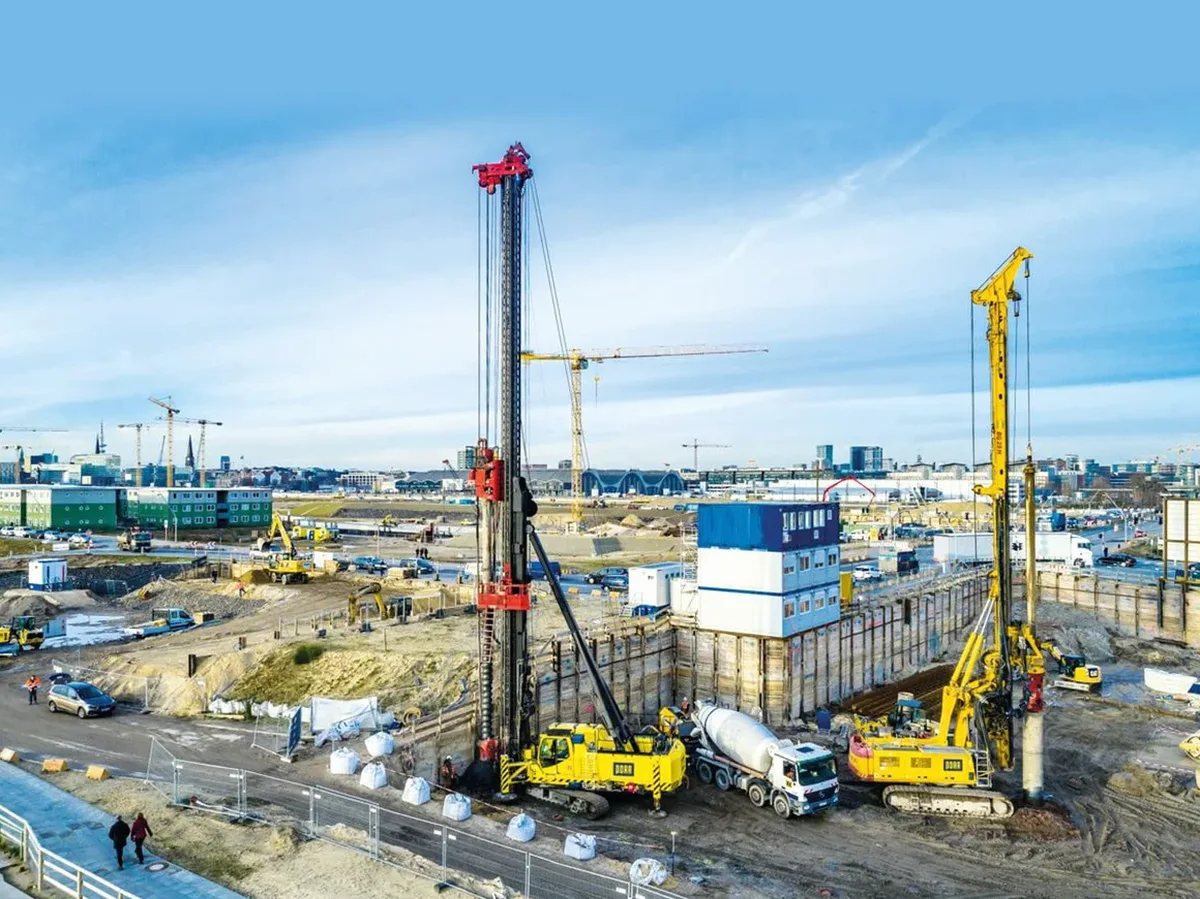
Socketing piles into competent Guelph dolostone transforms erratic bedrock into a predictable, high-capacity bearing stratum.
Scope of work in Guelph
Local geotechnical conditions in Guelph
Guelph sits at roughly 334 meters above sea level, but the real risk lies underground. The Amabel dolostone beneath the city is infamous for karst features—dissolution channels, cavities, and pinnacles that can swallow construction budgets whole. A pile designed without a thorough rock probing program risks terminating on a thin rock bridge over a void. The 2014 Geological Survey of Canada report on the Guelph area highlighted unpredictable bedrock conditions as a primary geohazard. Ignoring these features leads to sudden loss of drilling fluid, casing collapse, or catastrophic pile failure during static load testing. Our risk mitigation protocol requires probe drilling to a depth of at least twice the socket length below every pile tip, confirming solid rock continuity. For projects in the downtown core, where vibration-sensitive heritage limestone buildings are common, we specify drilled shafts over driven piles to eliminate settlement-inducing vibrations during installation.
Our services
The pile design process for Guelph conditions requires a tight integration of field data and analytical modeling. These three core service packages cover the full project lifecycle.
Geotechnical Investigation for Piles
Includes borehole drilling to minimum 6 m into competent Guelph dolostone, packer testing in rock, and laboratory strength testing to define design parameters for socket friction and end bearing.
Pile Capacity Analysis & Structural Design
Calculation of factored geotechnical resistance and structural capacity per NBCC limit states design, with detailed pile cap reinforcement drawings and group effect reduction factors.
Construction Monitoring & PDA Testing
Full-time inspection during drilling and concreting, including Pile Driving Analyzer (PDA) testing on sacrificial piles to validate design assumptions before production drilling begins.
Common questions
What is the typical cost range for a pile foundation design package in Guelph?
How deep do piles typically need to go in Guelph to reach good rock?
It varies significantly by neighborhood. In the south end near the Hanlon Expressway, competent Guelph dolostone often appears between 3 and 6 meters below grade. In the downtown core or near the river, we've encountered weathered zones extending to 10 meters, requiring longer sockets to bypass karstic voids.
Does the NBCC require a specific factor of safety for rock-socketed piles?
The NBCC 2020 doesn't prescribe a single factor of safety. It mandates a limit states design approach with geotechnical resistance factors varying by investigation thoroughness. For rock sockets based on detailed core logging and lab testing, we can justify a resistance factor of 0.5 to 0.6 for shaft friction, which is more advantageous than the standard 0.4 applied to axial capacity from SPT data alone.