Guelph sits at roughly 335 meters above sea level on a landscape shaped by the last glaciation, leaving behind the Paris-Galt moraine and the distinctive Guelph drumlin field. These landforms create a patchwork of dense silty clay tills, interbedded with sand and gravel lenses that challenge foundation design across the city. A standard penetration test provides an index of relative density, but when a project demands precise strength parameters for stability analysis, the triaxial test becomes the reference tool. Our laboratory, operating under ISO 17025 accreditation, runs consolidated-undrained and consolidated-drained triaxial programs to isolate effective stress parameters that govern long-term settlement and bearing capacity. For projects near the Speed River where groundwater complicates excavation, we often pair triaxial data with slope stability modeling to define safe cut angles. The test also supports finite element analysis by delivering stiffness degradation curves that capture the real behavior of Guelph till under working loads.
A well-executed triaxial program on Guelph till reveals that effective cohesion can drop from 15 kPa to near zero with just a 2% increase in water content.
Scope of work in Guelph
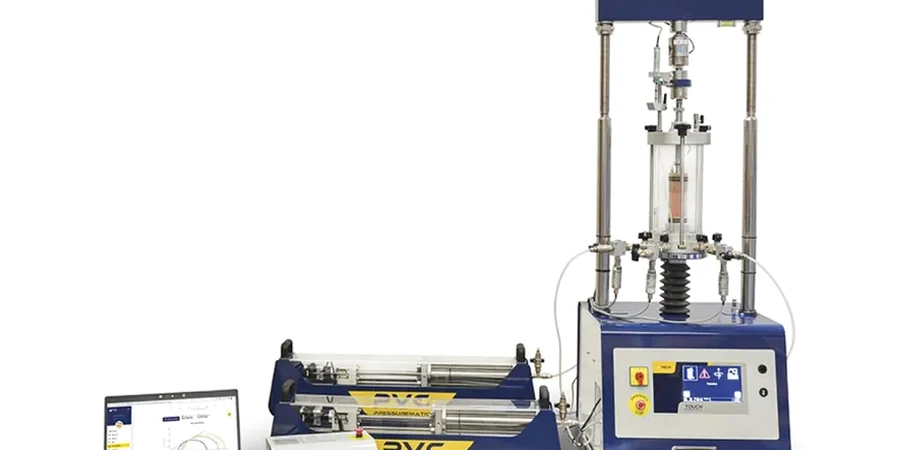
Live process video
Local geotechnical conditions in Guelph
Guelph's climate swings from saturated spring thaws to dry summer conditions, creating a natural cycle of pore pressure fluctuation in the upper 3 to 5 meters of soil. A total stress triaxial test run on a sample at its natural water content might overestimate strength by 20 to 30 percent compared to the effective stress parameters that govern drained conditions in the field. The risk appears most clearly in excavations near the Eramosa River, where a drawdown in groundwater level can trigger consolidation settlements in clay layers. Our lab addresses this by running back-pressure saturation and consolidation stages that match the worst-case groundwater scenario. When the project involves a deep basement in the downtown Guelph area, we often recommend a mat foundation design that uses the triaxial-derived effective cohesion to distribute loads and reduce differential settlement across the variable till contact.
Our services
Each triaxial program in Guelph is designed around the specific loading path and drainage conditions the project will experience. We work with geotechnical consultants to select the right test type and consolidation stress history.
Consolidated-Undrained (CU) with Pore Pressure
The standard for slope stability and embankment analysis on Guelph till. Measures excess pore pressure during shear to derive effective stress Mohr-Coulomb parameters c' and φ'. Includes B-value checks and isotropic consolidation to estimated in-situ stress.
Consolidated-Drained (CD) Triaxial
Applied when assessing long-term drained strength for retaining wall backfill design. Shearing proceeds slowly enough to allow full pore pressure dissipation, yielding critical state friction angles used in advanced constitutive models.
Multi-Stage Triaxial with Local Strain Measurement
A resource-efficient approach for Guelph projects with limited Shelby tube recovery. One specimen undergoes shearing at three increasing confining pressures, producing a complete failure envelope while minimizing sample variability.
Common questions
How much does a triaxial test program cost for a Guelph project?
What sample quality is required for a reliable triaxial test on Guelph till?
Shelby tube samples with a recovery ratio above 90% and no visible disturbance work well. We trim specimens to a 2:1 height-to-diameter ratio and run B-value saturation checks above 0.95 before shearing. Block samples from test pits can provide even better specimen quality for sensitive silts.
How long does a triaxial testing program take?
A CU triaxial program with three effective confining pressures generally requires 7 to 10 working days. The consolidation phase, where the specimen reaches equilibrium under back pressure, takes 24 to 48 hours per stage. CD tests run longer due to the slow shearing rate needed for drainage.
Can triaxial data be used directly in slope stability software?
Yes. The effective stress parameters c' and φ' derived from CU testing feed directly into limit equilibrium programs like Slide or SLOPE/W. For finite element analysis with PLAXIS, we can also provide the secant modulus E50 and stress-strain curves required for the hardening soil model.